Elektro-L5 · 1693 MHz · Russia
The first one we caught ourselves
The L2 decode read a recording someone else made. This time the satellite is Elektro-L5, and the recording is ours: received on our own dish, decoded down to clean frames, and now read all the way through to the instruments inside. The radiation monitor's own energy-sweep spectra, off our own antenna.
What we did
- Received Elektro-L5 on our own dish, a hand-pointed rig, across a short capture window.
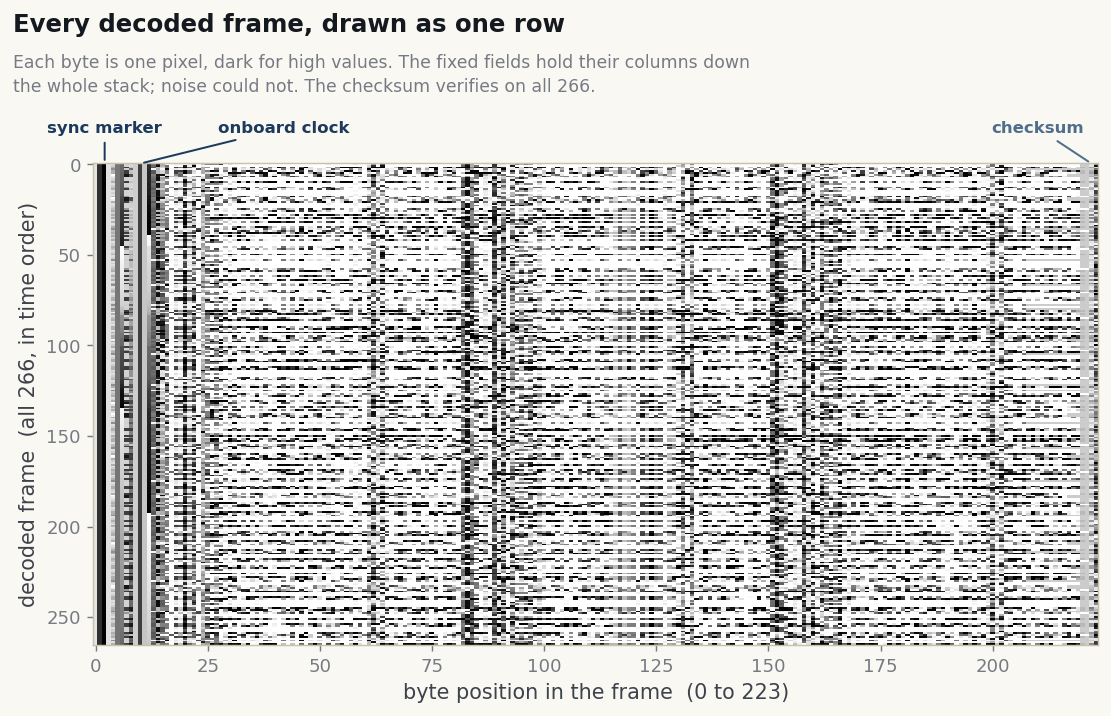
- Recovered the suppressed carrier, found the 224-byte frames, and confirmed the built-in checksum on every clean frame.
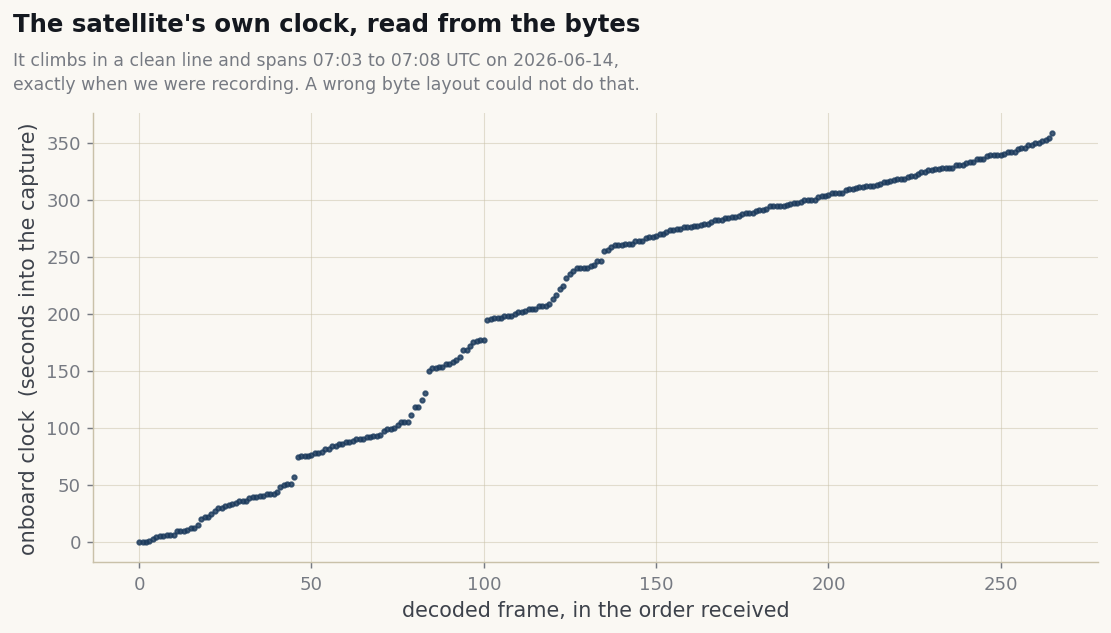
- Read the satellite's onboard clock out of the frame bytes. It matched the time of the capture to the second, which is the proof the byte layout is right and the frames are real, not noise.
- Decoded the same capture a second time from scratch, on a fresh chain that shares no code with the first, then merged the two. Where both reads landed on the same frame they agreed to the bit, with no conflicts, which is a second independent proof on top of the checksum.
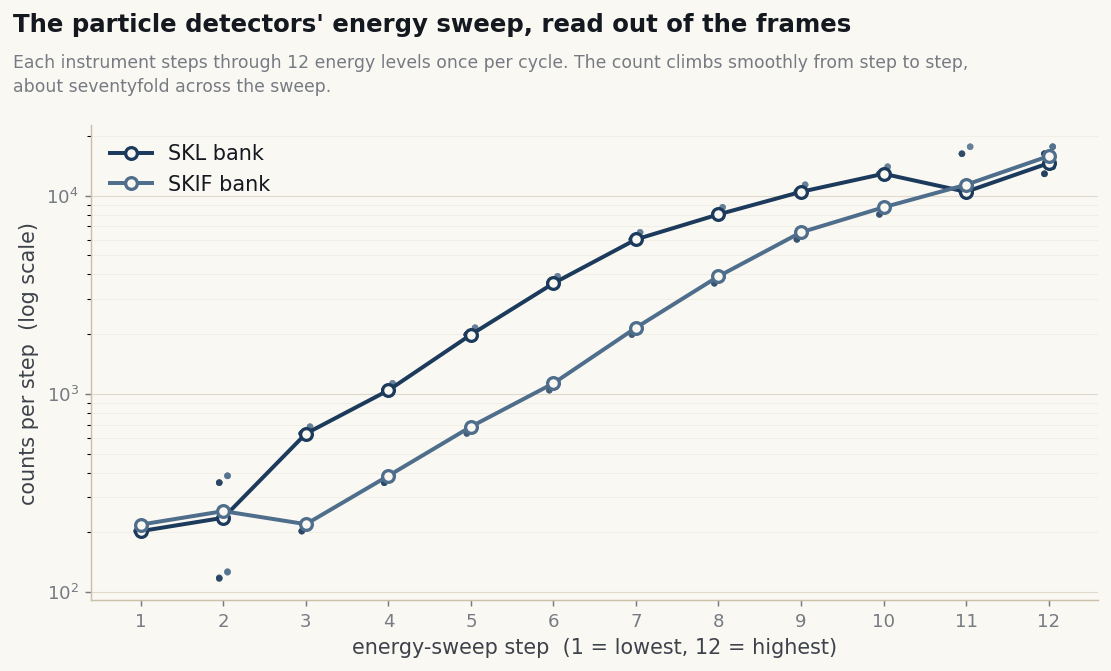
- Opened the instrument records inside each frame: the per-second particle counters for the two detectors, and the 12-step energy sweep each one runs. These read cleanly, with every internal counter matching the onboard clock.
Why it was hard
L2 came from a long, clean recording. Ours is short, hand-pointed, and weak, so the usual approach falls apart. What worked: keep the raw radio samples instead of a downsampled copy; find the few seconds where the dish was actually on the bird; recover the carrier by squaring the signal; and detect each frame's start marker rather than assuming a fixed grid, because the onboard clock drifts. Then correct the phase frame by frame.
The proof
Two checks say these are real frames, not a lucky pattern in noise.
Reading the instruments
A clean frame is a container. Inside are the actual measurements: two particle detectors, each reporting once a second, each stepping through twelve energy levels in turn. We unpacked those records and pulled the sweep out. The count climbs smoothly across the twelve steps, about seventyfold from the lowest to the highest, on both detectors. That smooth climb is the shape a working energy sweep should have, and it is the first time we have read it off L5.
Where it stands
L5 now decodes to clean frames off our own antenna and reads through to the instrument records inside, which is further than this had been taken here before. What is still open is calibration: turning the raw counts into physical flux, the way L2 was pinned against published curves. L2 had public reference data to check against. L5 does not yet, because the satellite is still being commissioned, so for now the channel meanings rest on the L5 to L2 family resemblance rather than a direct match. Longer, cleaner captures from the permanent Lucknow 1 m dish, plus published L5 data when it appears, are what close that last gap.
Capture: this station, 60 cm dish, June 2026. Frame format and the byte-level groundwork: our earlier Elektro-L2 decode. Frames: two independent demodulators of ours, run over the same recording and merged.